Proof marketing
Contractor Portfolio Website: 9 Things Every Project Page Needs
A practical guide to building contractor project pages that show the work clearly, earn trust, support local search, and turn interested homeowners into real inquiries.
Quick answer
A strong contractor portfolio website does more than display finished photos. Each project page should identify the job, location, problem, scope, process, result, proof, relevant services, and one clear next step. Use real before-and-after images, specific plain-language details, and an honest customer review when available. The goal is to help a prospect with a similar project quickly think: “They have solved my kind of problem before.”
A portfolio is not a photo dump
The best contractor portfolio websites organize proof around the questions a serious prospect is already asking: Have you handled a job like mine, near me, and did it turn out well?
Most contractors already have enough material for a useful portfolio. It is sitting in a camera roll: the stained deck before cleaning, the torn-off roof, the new siding in afternoon light, the client standing in the driveway after the walkthrough.
The weak version is a gallery called “Our Work” with dozens of unlabeled photos. It may look impressive for a few seconds, but it leaves the visitor to figure out what changed, where the job happened, and whether the work is relevant to them.
A project page adds that missing context. It turns a set of images into evidence. The page does not need a long case study or polished marketing language. It needs a clear story that a homeowner can understand in under two minutes.
Choose projects that match the work you want next
Build the portfolio around future revenue, not around every job you have ever completed.
Start with five to ten projects that represent the jobs you want more often. A roofer might choose an architectural-shingle replacement, a storm-damage repair, and a difficult low-slope section. A remodeler might show a kitchen, a primary bathroom, and a whole-home renovation at three different budget levels.
A useful first set usually includes:
Do not wait for a perfect luxury project. A well-documented everyday job is often more persuasive because the prospect can recognize their own house, problem, or budget in it.
Remove duplicate angles, blurry shots, screenshots, and photos that reveal private information. Five purposeful images will usually tell a stronger story than twenty nearly identical ones.
- Your most common profitable service
- A visually dramatic before-and-after result
- A job that solved a difficult or unusual problem
- A project in an important service area
- A result backed by a specific customer review
- A project that shows a different property style or scope
The nine things every contractor project page needs
Give every page a consistent structure so visitors can scan it quickly on a phone.
The exact layout can change with your brand, but the information should stay predictable. These nine elements cover the questions most prospects need answered before they contact you.
This structure works because it combines visual proof with enough detail to make the proof believable. It also gives search engines and AI answer systems plain language that explains what the images represent.
- A specific project title. “Cedar deck restoration in Portland” is more useful than “Project 17.”
- The city or service area. Use the real location at city level when the customer is comfortable with it; never publish a private street address.
- The service performed. Name the actual work, such as roof replacement, cabinet refinishing, driveway sealing, or landscape installation.
- The starting problem. Explain what the customer wanted fixed or improved.
- The scope. List the important surfaces, systems, materials, or stages included in the job.
- The process. Briefly describe how your team approached the work, especially any detail that demonstrates care or skill.
- The finished result. State what changed in concrete terms without exaggeration.
- Proof. Add before-and-after photos, a verified review, relevant credentials, or a completion detail.
- One next step. Ask the visitor to request an estimate, call, or view a related project. Do not make them choose between six competing buttons.
Take photos that tell the whole job story
Capture the same area before, during, and after the work, from a repeatable angle whenever possible.
Before-and-after pairs are effective because the comparison is immediate. The biggest improvement is not a more expensive camera; it is consistency.
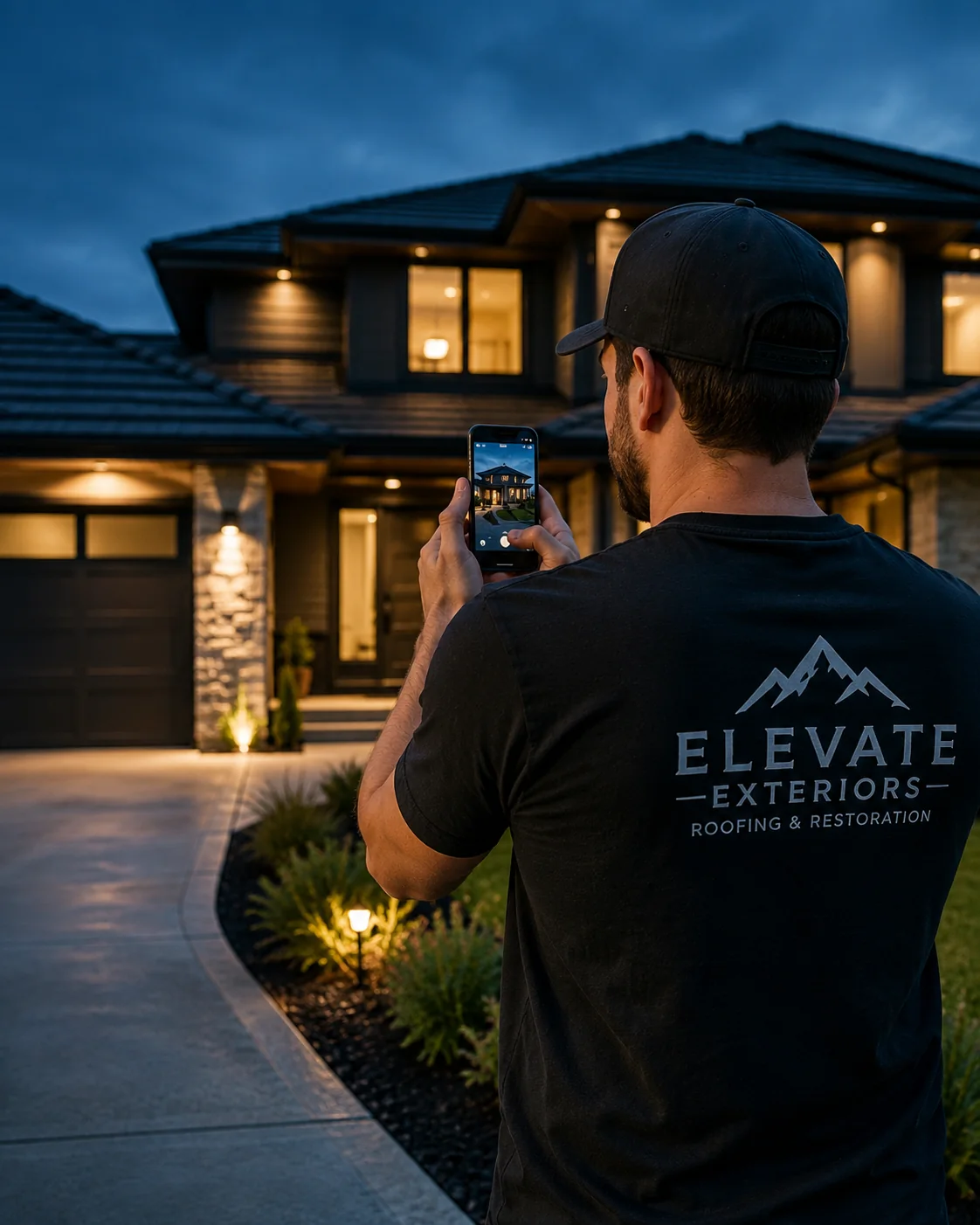
Stand in the same place, hold the phone at a similar height, use the same orientation, and keep major lines of the property in roughly the same position. Clean the phone lens. Shoot in daylight when possible. Step back far enough to show context, then capture two or three details that demonstrate workmanship.
A simple field sequence is enough:
Use descriptive image names and accurate alt text when the publishing tool allows it. Google says image context and alt text help it understand what an image shows. “New charcoal architectural shingles on a two-story home in Maple Grove” is useful. Repeating a keyword ten times is not.
- One wide photo before work begins
- Two or three closeups of the main problem
- One process photo that shows the work underway
- One wide photo from the original position after completion
- Two or three finished details
- One optional handoff photo, only with the customer’s permission
Write the project copy like a professional, not an ad
Specific details sound more credible than superlatives.
You do not need to call every result stunning, flawless, premium, or transformative. Those words are easy to write and hard to prove. Describe what the customer could actually see or experience.
A useful three-part formula is:
For example: “The homeowners wanted to restore the deck without hiding the cedar grain. We replaced two damaged boards, cleaned the surface, sanded the high-traffic areas, and applied a semi-transparent stain. The finished deck kept its natural look while gaining a more even, weather-resistant surface.”
That paragraph is stronger than “We completely transformed this beautiful outdoor space.” It tells a future customer what you noticed, what you did, and what changed.
Keep paragraphs short. Avoid trade jargon unless you explain it. If a material or method matters to the decision, include it. If it does not help a homeowner judge the fit, leave it out.
- Problem: what was worn, damaged, outdated, unsafe, or no longer working
- Work: what your team repaired, replaced, cleaned, installed, or improved
- Result: what became more durable, usable, attractive, efficient, or easier to maintain
Add local relevance without making a doorway page
Location details should help the reader understand the project, not exist only to repeat a city name.
A real project page naturally connects a service with a place. That can support local discovery because the page contains evidence that the company performs that work in that area. The evidence matters more than stuffing the city into every sentence.
Include the city or neighborhood at a sensible privacy level, the service, the property type, and any local condition that shaped the work. A drainage project might mention clay soil. An exterior coating project might discuss coastal exposure. A roof page might explain the ventilation or weather issue found during inspection.
Google says local results are mainly influenced by relevance, distance, and prominence. No single project page can control all three. What it can do is improve relevance and give people a credible page to visit, link to, and share.
Avoid creating dozens of near-identical pages where only the city name changes. Each indexed page should represent a real project and contain original photos and details. That is useful to visitors and consistent with Google’s guidance to create substantial, people-first content.
Use reviews as proof, not decoration
Pair the project with a real review that speaks to the same job whenever the customer has given permission.
A row of five orange stars looks nice, but a specific sentence is more convincing. “The crew protected the landscaping and cleaned up every evening” answers a concern that a homeowner may genuinely have.
BrightLocal’s 2026 U.S. consumer survey found that two in five consumers read reviews every time they look for a business. Reviews also appear in Google’s own local-ranking guidance: more reviews and positive ratings can help a business stand out and may support prominence.
Use the customer’s words accurately. Do not rewrite a mixed review into a glowing testimonial, invent a name, or imply that an unusual result is typical. The Federal Trade Commission says endorsements must reflect the honest experience or opinion of the endorser and cannot make claims the business could not substantiate directly.
Good review placement is simple: place the quote after the result, identify the source when permitted, and link to the original review platform if practical. If the customer asked to remain private, use a truthful label such as “Homeowner in St. Paul” rather than a fabricated full name.
A worked example: from camera roll to project page
Here is what a concise exterior-painting project could look like.
Title: Two-story exterior repaint in Beaverton, Oregon.
Starting point: The south-facing siding had faded unevenly, while several trim boards showed peeling paint around the windows.
Scope: Wash and prepare the exterior, scrape and spot-prime failing areas, recaulk open joints, apply two finish coats to the siding, and repaint the trim and front door.
Process: The crew protected the roof, landscaping, lighting, and hardscape before preparation. Damaged caulk was removed rather than painted over. The team used a repeatable daily cleanup so the homeowners could continue using the driveway.
Result: The siding returned to an even color, the trim lines read cleanly from the street, and the exposed joints were resealed before the wet season.
Proof: Add one wide before-and-after pair, a closeup of the repaired trim, a process photo showing protection and preparation, the coating system used, the month completed, and the customer’s review.
Next step: “Planning an exterior repaint in the Portland area? Request an estimate.”
Notice what is missing: inflated claims, a fake percentage increase, and a wall of keywords. The page is persuasive because it makes the work easy to inspect.
Publish once, then reuse the project
A finished project page should become the source for several smaller marketing assets.
The page is the durable version of the story. Once it is live, reuse it instead of writing every channel from scratch.
Keep the original project page as the source of truth. If a material name, completion date, or testimonial changes, update it there first.
- Share the project link in an estimate follow-up when the prospect has a similar property
- Turn the before-and-after pair into a Google Business Profile update
- Use one project detail as an Instagram or Facebook caption
- Export a short PDF for an in-person sales conversation
- Ask the customer for a review while the result is still fresh
- Add the page to a service or location page where it genuinely supports the claim
- Send it to referral partners who may know someone with the same problem
Measure whether the portfolio helps people act
Track useful actions, not just page views.
Views tell you whether a page is being discovered. They do not tell you whether the page is helping a visitor move forward.
Track estimate-request clicks, phone clicks, form submissions, shares, and the pages viewed before an inquiry. Compare projects by service and location. If visitors repeatedly view deck projects before requesting a deck estimate, that is useful evidence about what to feature more prominently.
Also watch for practical quality signals: Are visitors reaching the result and review sections? Do sales conversations reference a specific project? Are team members actually sharing the pages after an estimate? The best portfolio is not the one with the most projects. It is the one that makes choosing your company easier.
Common questions
Questions this guide answers
What should a contractor portfolio website include?+
Include a clear service and location, the customer’s starting problem, the project scope, a short explanation of the process, before-and-after photos, the finished result, credible proof, and one clear call to action.
How many projects should a contractor portfolio have?+
Start with five to ten strong projects that represent the work you want more of. Three complete, relevant project pages are more useful than fifty unlabeled photos, and you can add new jobs over time.
Do contractor project pages help local SEO?+
They can improve relevance by connecting real services, places, photos, and project details on one useful page. They are not a shortcut to rankings, and near-duplicate city pages should be avoided.
Should I include prices in my contractor portfolio?+
Include a price range only when it will remain accurate and helps prospects qualify themselves. Otherwise explain the factors that affected the scope, such as size, access, material, repair needs, and finish level.
Can I use a customer review on a project page?+
Yes, when the review is genuine and you have the right to use it. Preserve the customer’s meaning, identify the source when practical, and never invent or selectively rewrite a testimonial.
What photos should I take after a contractor job?+
Take a wide finished view from the original before-photo position, two or three workmanship details, and an optional customer handoff photo with permission. Remove photos that reveal addresses, documents, license plates, or other private details.
Sources and further reading
Put the guide into practice